
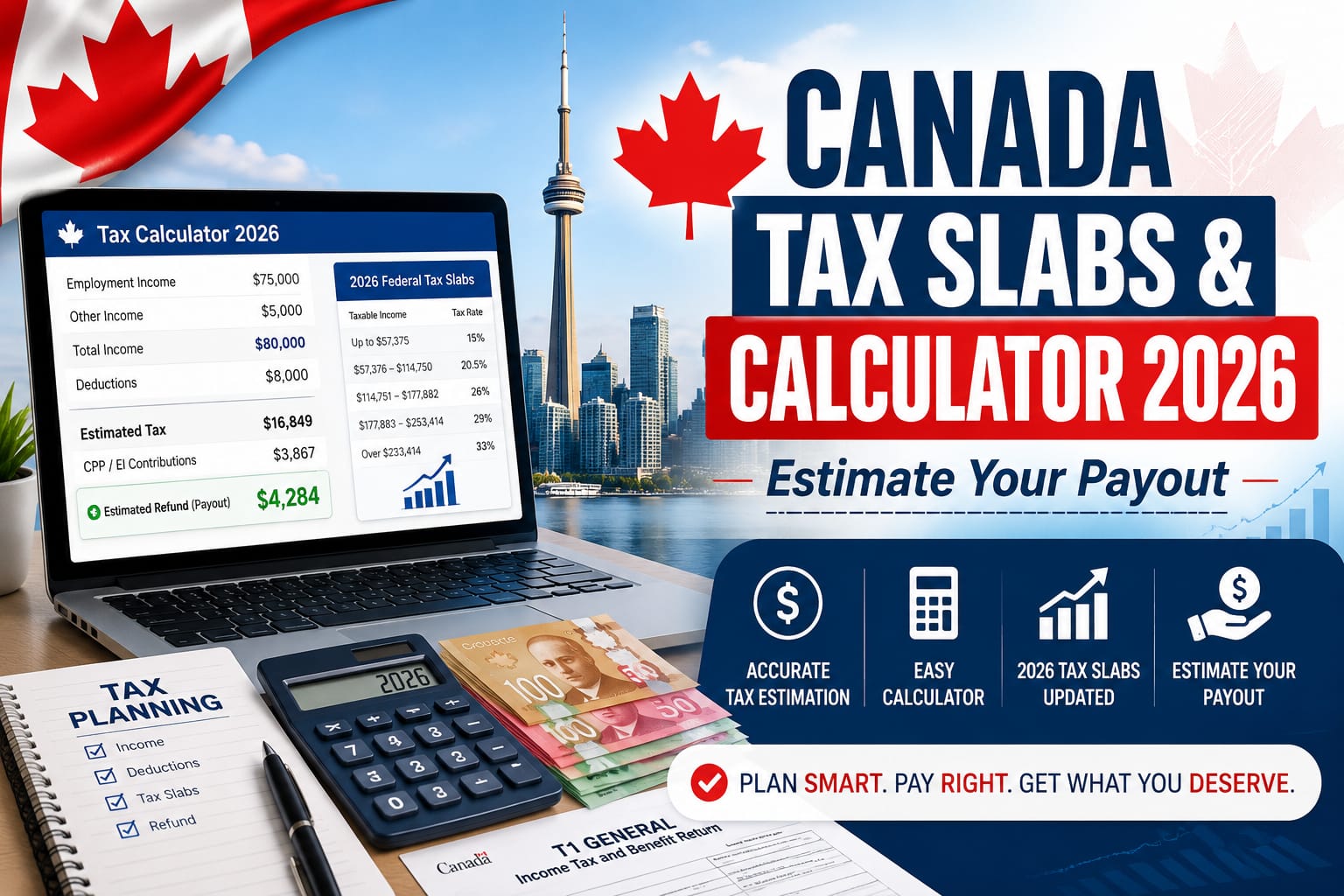
Canada Tax Slabs and Calculator 2026:
Estimate Your Payout
Managing a household budget or running a growing enterprise in Canada requires a clear view of your net financial metrics. With shifting cost-of-living adjustments and annual regulatory updates, understanding exactly how much of your paycheck goes toward government revenues is essential to protecting your disposable income. Accurate estimation prevents unexpected year-end tax bills and allows for proactive wealth building.
If you are looking for an intuitive way to track your income deductions, mastering the Canada tax slabs and calculator 2026 frameworks is the most effective approach. The federal government has introduced indexed income brackets alongside provincial adjustments to provide financial breathing room. This comprehensive guide breaks down the updated tax slabs, explains how progressive marginal systems work, and demonstrates how Assentt can optimize your deductions to maximize your net take-home pay.
Understanding the 2026 Federal Canada Tax Slabs
Canada operates under a progressive taxation framework. This means your entire annual income is not taxed at one flat rate; instead, your earnings are divided into slices, and each slice is taxed at a progressively higher rate as your income crosses specific thresholds.
To help fight "bracket creep" caused by inflation, the Canada Revenue Agency (CRA) adjusted all federal thresholds upward. The official federal Canada tax slabs and calculator 2026 brackets are structured as follows:
-14% on the portion of taxable income up to $58,523
-20.5% on the portion of income between $58,523.01 and $117,045
-26% on the portion of income between $117,045.01 and $181,440
-29% on the portion of income between $181,440.01 and $258,482
-33% on any portion of taxable income that exceeds $258,482
Note: The lowest federal tax bracket sits permanently at 14% (down from its historical 15%), providing baseline tax relief to every working resident across the country.
The Role of Provincial Tax Slabs in Your Calculations
Your final tax liability is a combination of two separate layers: the federal slabs listed above, and the provincial or territorial slabs based on where you reside on December 31st of the tax year. Each province sets its own specific thresholds and rates, which must be factored into any accurate Canada tax slabs and calculator 2026 tool.
For instance, premier business and employment hubs feature distinct marginal systems:
- Ontario (ON): Utilizes a five-tier provincial system ranging from 5.05% to 13.16%, plus an additional Ontario Surtax for higher income brackets.
- British Columbia (BC): Features a progressive seven-tier framework starting at 5.06% and scaling up to 20.5% for premium earners.
- Alberta (AB): Employs a multi-tier progressive system starting at 10% for baseline income blocks.
When you use a comprehensive tax calculator, it merges your specific provincial slabs with the federal brackets to reveal your true Marginal Tax Rate (the tax paid on your next dollar of income) and your Average Tax Rate (the total tax paid divided by your total gross income)
How to Calculate Your Take-Home Pay Manually
To see how these slabs interact in real life, let’s look at a practical example.
Suppose your total taxable income as an individual residing in Ontario for the year is $70,000.An accurate calculator will break down your federal tax obligation into these progressive steps:
1. First Slice: You pay exactly 14% on the first $58,523, which equals $8,193.22.
2. Second Slice: You only pay 20.5% on the remaining balance that sits in the second bracket ($70,000 minus $58,523 = $11,477). This equals $2,352.79.
3. Total Federal Tax: Combining both slices gives a total of $10,546.01 (before applying provincial taxes, basic personal amounts, or CPP/EI credits).
Frequently Asked Questions (FAQ)
Q1. What is the Basic Personal Amount (BPA) for this tax year?
The federal Basic Personal Amount (BPA) is indexed to $16,452 for most Canadian taxpayers. This means you do not pay any federal income tax at all on the first $16,452 of your annual earnings, providing an immediate non-refundable tax credit right at the base of your calculations.
Q2. How do RRSP contributions alter my tax slab positioning?
Registered Retirement Savings Plan (RRSP) contributions are directly tax-deductible. If your gross income is $65,000 (putting you in the 20.5% federal slab) and you contribute $7,000 to your RRSP, your net taxable income drops to $58,000. This intentional strategy pulls your highest income dollars out of the second slab and moves them down into the lower 14% bracket, triggering a significant tax refund.
Q3. Why does my paycheck show higher deductions than the tax slabs state?
Your employer is legally mandated to withhold source deductions beyond income tax. Your paycheck reductions also include mandatory contributions to the Canada Pension Plan (CPP) and Employment Insurance (EI) premiums. A fully functional payroll calculator accounts for these separate federal programs.
Q4. Does a corporate business owner use personal tax slabs?
In corporate structures, business profits are taxed at low corporate tax rates (typically 11% to 13% under the Small Business Deduction). However, the moment you withdraw money from your corporation as a personal salary or a dividend, that personal income is subject to the standard individual tax slabs. Balancing corporate and personal slabs is the core of advanced tax planning.
How Assentt Optimizes Your Year-End Tax Results
Plugging numbers into a generic online calculator can give you a rough estimate, but it cannot replace strategic financial analysis. Managing complex income streams, corporate structures, and shifting regional deductions by yourself can cause you to overlook valuable credits or make costly structural errors.
At Assentt, we convert raw numbers into customized wealth-protection strategies. Our dedicated personal and corporate tax specialists review your complete financial landscape to ensure your income framework is perfectly balanced to minimize your overall tax burden.
We support Canadian taxpayers through professional financial services:
-Personal Tax Planning & Prep: Structuring deductions and filings to maximize your year-end cash returns.
-Corporate Accounting & Bookkeeping: Keeping business ledgers immaculate, compliant, and optimized for corporate tax rates.
-Payroll & Source Deduction Setup: Helping small businesses execute flawless employee payroll calculations and CRA remittances.
-CRA Audit Defense & Representation: Managing all communications, notices, and compliance checks securely on your behalf.
Take absolute control of your financial math and protect your hard-earned revenue. Contact the tax planning specialists at Assentt today to book your comprehensive financial consultation.