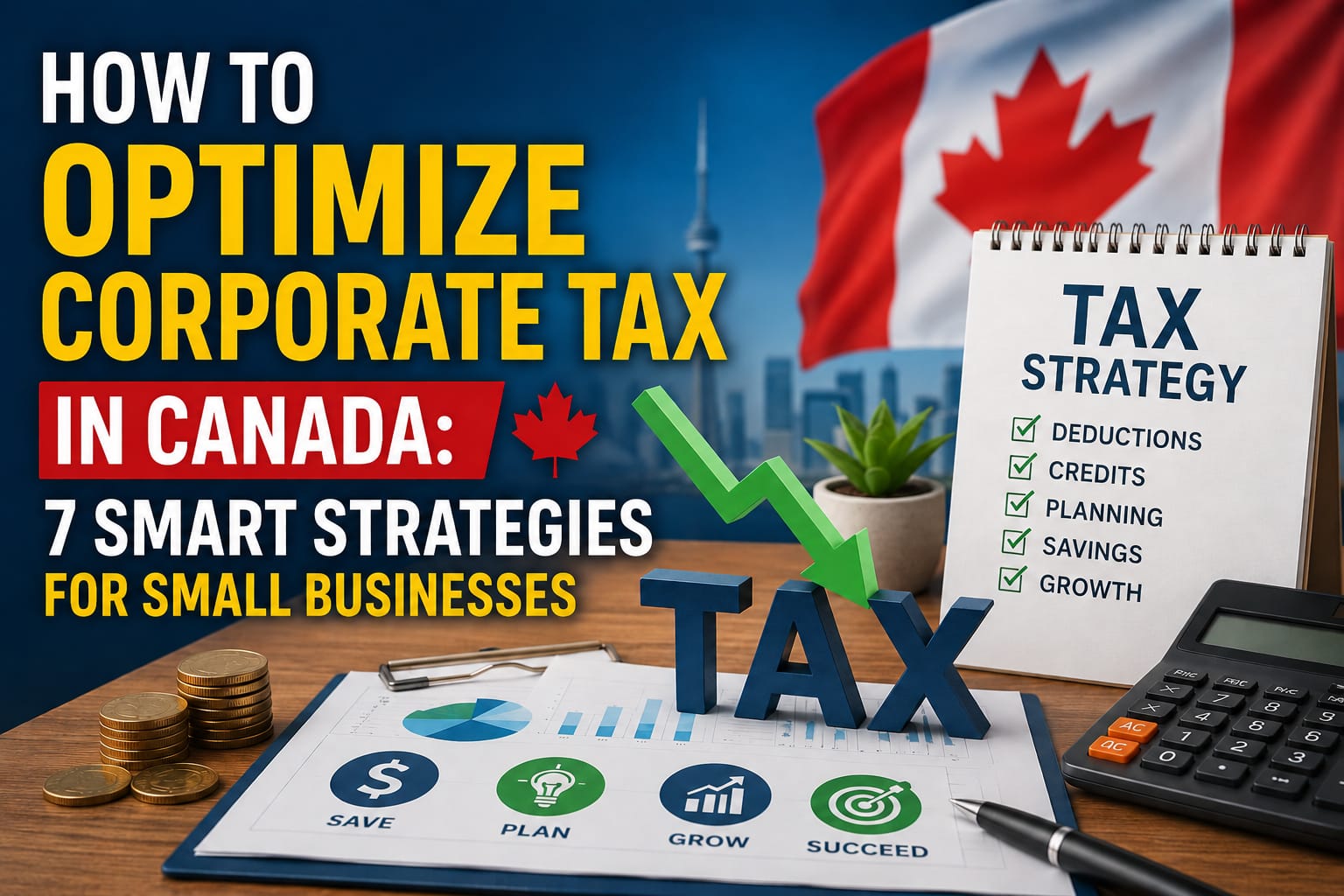
How to Optimize Corporate Tax in Canada
7 Smart Strategies for Small Businesses
Running a business in Canada is a rewarding venture, but the tax burden at the end of the fiscal year can stress any business owner. Did you know that with strategic tax planning, you can legally save thousands of dollars?
If you are wondering how to optimize corporate tax in Canada, you are in the right place. This guide explains how to optimize corporate tax using practical strategies that can reduce your tax liability, improve cash flow, and support long-term business growth. We will also explore how the expert team at Assentt can simplify your corporate financial planning.
Understanding the Corporate Tax Rate in Canada
Before diving into tax-saving strategies, it is essential to understand how Canadian corporate tax works. Corporate tax is levied at two levels:
-Federal and Provincial/Territorial.
The Canadian government supports small businesses through the Small Business Deduction (SBD). Under this program, the federal tax rate on the first $500,000 of active business income is just 9%. When combined with provincial taxes, the total corporate tax rate canada usually ranges between 11% and 13%, depending on your province. For income exceeding $500,000, the general corporate tax rate jumps significantly to between 27% and 31%.
7 Smart Strategies on How to Optimize Corporate Tax
To prevent a large portion of your hard-earned revenue from going to taxes, you can implement these proven corporate tax planning strategies. Understanding how to optimize corporate tax helps businesses improve profitability while remaining compliant with CRA regulations.
1. Maximize CRA Business Expenses Deductible
The golden rule of tax reduction is to claim every legitimate business expense. According to CRA business expenses deductible guidelines, you can write off write-offs for operational costs like:
-Office rent and utilities
-Employee salaries, wages, and benefits
-Business travel and vehicle transportation expenses
-Marketing, advertising, and professional fees (such as Assentt's accounting fees)
2. Pay Yourself: Salary vs. Dividends
As a business owner, you can draw money from your corporation as either a salary or dividends.
-Salary: This counts as a direct business expense, which reduces your corporation’s taxable income. Drawing a salary also creates RRSP (Registered Retirement Savings Plan) contribution room.
-Dividends: These do not reduce corporate tax, but they are taxed at a lower personal rate and do not require Canada Pension Plan (CPP) contributions. Mixing both effectively requires professional advice. advice.
3. Claim Scientific Research and Experimental Development (SR&ED)
If your business is innovating, developing software, or improving products in Canada, you can leverage the SR&ED tax incentive program. This is Canada’s largest R&D tax incentive program. It offers substantial cash refunds or tax credits based on your eligible research expenses.
4. Utilize Individual Pension Plans (IPP)
If you are an incorporated business owner over the age of 40 with a high salary, an Individual Pension Plan (IPP) can beat a traditional RRSP. Contributions made to an IPP are fully tax-deductible for your corporation. This allows you to shield significantly more corporate income from taxes.
5. Invest in Capital Cost Allowance (CCA)
You cannot deduct the full cost of long-term business assets—like computers, machinery, or vehicles—in a single year. Instead, you claim tax deductions over time using the Capital Cost Allowance (CCA). Strategic asset purchases right before your fiscal year-end can yield immediate tax relief.
6. Declare Bonuses Before the Year-End
If your business is projecting a highly profitable year, you can declare bonuses for your employees or yourself. Under CRA rules, if you declare a bonus before your fiscal year-end, you can deduct it as a current-year expense, provided it is paid out within 180 days.
7. Carry Forward or Backward Business Losses
Business cycles fluctuate, and some years bring losses instead of profits. If your business experiences a Net Capital or Non-Capital Loss, you can carry it back up to 3 years to recover taxes previously paid. Alternatively, you can carry it forward for up to 20 years to offset future profitable years.
Frequently Asked Questions (FAQ)
Q1. Why Learning How to Optimize Corporate Tax Matters?
Knowing how to optimize corporate tax is about more than simply reducing taxes. Effective tax planning improves cash flow, supports business expansion, reduces financial risk, and helps ensure compliance with CRA requirements. By implementing the right strategies throughout the year, small businesses can retain more earnings and invest confidently in future growth.
Q2. What are the most common small business tax deductions in Canada?
Common small business tax deductions Canada include commercial rent, office supplies, business insurance, raw materials, professional fees, and eligible automobile expenses used for business travel.
Q3. Can I deduct home office expenses if I run an incorporated business?
Yes. If you work primarily from home or use a specific home space exclusively to meet clients, your corporation can rent that space from you or reimburse a percentage of household utilities, internet, and maintenance.
Q4. Is professional accounting fees tax deductible in Canada? Absolutely. Any fees you pay to a professional accounting and tax firm like Assentt for corporate tax preparation, payroll, or bookkeeping are considered legitimate business expenses and are 100% tax-deductible.
Q5. What is the deadline for filing corporate tax in Canada?
You must file your T2 corporate tax return within 6 months of your corporate fiscal year-end. However, if your corporation owes taxes, the actual payment deadline is usually 2 to 3 months after your year-end.
How Assentt Can Help You Save Taxes
Canadian tax regulations are highly beneficial if navigated correctly, but they are also incredibly complex. A simple accounting error can trigger costly penalties or invite a stressful CRA audit.
At Assentt, our expert team helps business owners optimize their financial performance. We analyze your corporate structure to build a customized tax-saving framework that fits your industry.
We provide end-to-end support across all essential financial pillars:
- Tax Planning: Designing corporate structures that legally minimize your tax burden.
- Accounting & Bookkeeping: Keeping your books audit-ready and aligned with CRA requirements.
- Incorporation Services: Helping startups register correctly at provincial or federal levels.
- CRA Representation: Managing communications and audits confidently on your behalf.
Whether you are looking to understand how to optimize corporate tax or need ongoing corporate tax planning support, Assentt provides personalized solutions designed for your business. Contact our team today to build a tax strategy that helps you reduce taxes, improve profitability, and achieve long-term financial success.
Learning how to optimize corporate tax is an important part of building a financially successful business in Canada. By claiming eligible deductions, planning compensation effectively, utilizing available tax incentives, and seeking professional guidance, your corporation can legally reduce its tax burden while remaining fully compliant with CRA requirements.