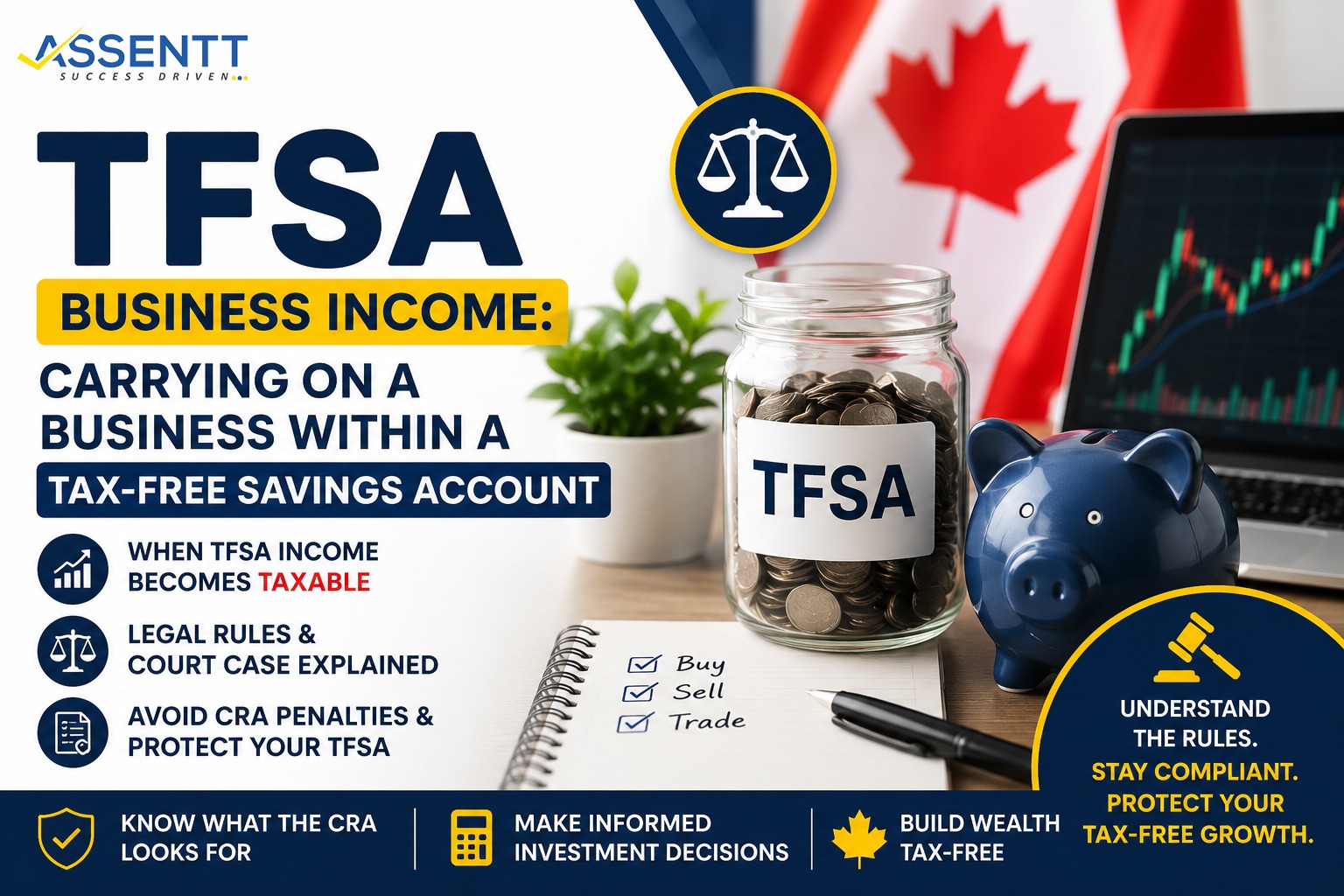
TFSA: Carrying on a Business Within a Tax-Free Savings Account
A Tax-Free Savings Account (TFSA) is one of Canada’s most valuable investment vehicles because qualifying investment income, capital gains, and withdrawals are generally tax-free. However, many investors are unaware that this tax-free treatment has an important exception.
If the Canada Revenue Agency (CRA) determines that your investment activities amount to carrying on a business, the income earned inside your TFSA may become taxable. This rule most commonly affects individuals who engage in frequent or business-like securities trading rather than long-term investing.
Understanding TFSA Business Income is essential for protecting the tax-free status of your investments and avoiding unexpected tax assessments. This guide explains how the CRA evaluates business income within a TFSA, discusses a significant Tax Court decision, and outlines practical steps investors can take to reduce risk.
What Is TFSA Business Income?
Under normal circumstances, income earned inside a TFSA—including interest, dividends, and capital gains—is exempt from Canadian income tax.
However, the Income Tax Act provides that income earned from carrying on a business inside a TFSA may be taxable.
In practice, TFSA Business Income most commonly arises when investment activities resemble those of a professional securities trader rather than an ordinary investor.
Importantly, earning substantial profits inside a TFSA does not automatically mean the income becomes taxable. Instead, the CRA looks at the overall nature of your investment activities before determining whether a business exists.
When Can the CRA Tax Your TFSA?
There is no specific rule stating that a certain number of trades automatically creates TFSA Business Income.
Instead, the CRA and the courts evaluate all the surrounding facts and circumstances.
Some of the factors commonly considered include:
- The frequency of buying and selling securities.
- The length of time investments are held.
- The taxpayer’s knowledge and experience in financial markets.
- The amount of time devoted to trading activities.
- Whether investments are speculative in nature.
- The intention to generate short-term trading profits.
- The organization and sophistication of the trading activity.
No single factor determines the outcome. Rather, the CRA evaluates the overall pattern of investment activity before concluding whether a TFSA is carrying on a business.
Common Myths About TFSA Business Income
Many investors misunderstand how the CRA applies the business income rules.
Myth 1: There is a maximum number of trades allowed.
There is no legislated limit on the number of trades you can make inside a TFSA. The CRA considers the overall nature of your activities rather than relying on a fixed threshold.
Myth 2: Large profits automatically become taxable.
Generating significant investment gains does not automatically create TFSA Business Income. Profit alone is not the deciding factor.
Myth 3: Only day traders are affected.
Although day traders face a higher risk of reassessment, the CRA evaluates each situation individually based on all relevant circumstances.
Understanding the 2023 Tax Court Decision
A significant Tax Court of Canada decision released on February 6, 2023, reinforced the CRA’s position regarding TFSA Business Income.
In this case, the TFSA holder was a professional investment advisor who actively traded speculative, non-dividend-paying penny stocks. Although the investments themselves were qualified investments for TFSA purposes, the trading activity was extensive, frequent, and highly organized.
Between 2009 and 2012, annual TFSA contributions of only $5,000 generated approximately $569,481 of investment income through aggressive securities trading.
The CRA concluded that the TFSA was carrying on a securities trading business and assessed tax on the income earned inside the account.

Why the Taxpayer Lost
The taxpayer argued that a TFSA should receive treatment similar to a Registered Retirement Savings Plan (RRSP), where different legislative provisions apply to certain business income situations.
The Court rejected this argument.
It explained that TFSAs and RRSPs are separate statutory regimes established under different legislative rules. Parliament intentionally chose to tax business income earned inside a TFSA.
The Court also confirmed that the long-established judicial tests for determining whether someone is carrying on a securities trading business remain applicable to TFSAs.
After reviewing the facts, the Court concluded that the taxpayer’s activities constituted a business because:
- Trading occurred frequently.
- Securities were held for short periods.
- The investments were speculative.
- The taxpayer possessed extensive professional investment expertise.
- Significant time was devoted to researching and executing trades.
Accordingly, the income earned inside the TFSA was taxable as TFSA Business Income.
Who Is Most at Risk?
Although every situation is unique, the CRA is more likely to review TFSAs where investors:
- Engage in frequent short-term trading.
- Buy and sell speculative securities.
- Treat investing as a full-time activity.
- Possess professional investment knowledge or experience.
- Conduct organized trading similar to a securities business.
These factors do not automatically result in taxation, but they increase the likelihood of a CRA review.
Who Is Generally Not at Risk?
Most Canadians who invest for long-term wealth accumulation generally do not need to worry about TFSA Business Income rules.
Examples include investors who primarily hold:
- Exchange-Traded Funds (ETFs)
- Mutual funds
- Dividend-paying stocks
- Blue-chip companies
- Bonds
- Guaranteed Investment Certificates (GICs)
Occasional portfolio rebalancing or realizing investment gains does not automatically mean your TFSA is carrying on a business.
Best Practices to Protect Your TFSA
To reduce the risk of having your TFSA classified as carrying on a business:
- Invest with a long-term strategy.
- Avoid excessive speculative trading.
- Maintain complete investment records.
- Do not use your TFSA as a day-trading account.
- Seek professional tax advice before adopting aggressive trading strategies.
Proper planning can help preserve the tax-free benefits that make the TFSA such a valuable investment vehicle.
TFSA Business Income vs. TFSA Contribution Limits
Many Canadians confuse TFSA Business Income with TFSA contribution rules.
These are entirely separate concepts.
Contribution limits determine how much you may contribute to your TFSA each year, while business income rules determine whether income earned inside your TFSA remains tax-free.
Frequently Asked Questions (FAQ)
Can the CRA tax income earned inside my TFSA?
Yes. If the CRA determines that your TFSA is carrying on a business, the business income earned inside the account may become taxable.
Is day trading prohibited inside a TFSA?
There is no legislation that specifically prohibits day trading. However, frequent or business-like trading may result in the CRA assessing the income as TFSA Business Income.
Is there a maximum number of trades allowed?
No. Canadian tax legislation does not prescribe a specific number of trades. The CRA evaluates all the facts surrounding your investment activities.
Can I hold Canadian and U.S. stocks inside a TFSA?
Yes. Many Canadian and U.S. publicly traded securities are qualified investments and may generally be held inside a TFSA, provided they meet the applicable requirements.
Does making a large profit automatically create TFSA Business Income?
No. Large investment gains alone do not make income taxable. The CRA considers the overall nature of your investment activities rather than focusing solely on profits.
How Assentt Can Help
Understanding TFSA Business Income rules can be challenging, particularly for active investors, incorporated business owners, and individuals managing significant investment portfolios.
At Assentt, we help clients navigate Canadian tax legislation while protecting both their personal and business financial interests.
Our services include:
- Personal Tax Planning
- TFSA & RRSP Planning
- Investment Tax Planning
- CRA Representation
- Tax Compliance Reviews
- Personal Tax Return Preparation
Whether you need assistance understanding TFSA rules, responding to a CRA inquiry, or developing a tax-efficient investment strategy, our experienced professionals can help you make informed financial decisions while remaining compliant with Canadian tax legislation.
Disclaimer
This article is provided for general educational purposes only and should not be considered legal, tax, or financial advice. Every taxpayer’s circumstances are different. Please consult a qualified tax professional or contact Assentt for advice tailored to your specific situation.
If you would like to learn more about annual contribution limits, read our guide:
👉 TFSA Contribution Limit 2026
If you would like to understand how contribution room works, including carry-forward rules and withdrawals, see:
Disclaimer
This article is provided for general educational purposes only and should not be considered legal, tax, or financial advice. Every taxpayer’s circumstances are different. Please consult a qualified tax professional or contact Assentt for advice tailored to your specific situation.